
“Policy discretion” is a polite phrase for economic and market manipulation, and far from failing to hold back the decline of the global fiat currency system, it is contributing to it.
Conventional investment management and financial planning isn’t built to see it, let alone act on it. At the one moment it matters most, it’s working against your best interest.
Anything short of best-practice investing has become high-risk gambling. We’ve shown an optimized compounding process that beats the alternatives over the long term, and that matters more now than at any point in your lifetime.
In a letter to Thomas Jefferson on August 25, 1787, John Adams wrote:
“All the perplexities, confusion, and distress in America arise, not from want of honor or virtue, but from the downright ignorance of the nature of coin, credit, and circulation.”
It’s time to stop being naïve about how fiat currency systems work, and to take the historical record seriously. Across three thousand years, every fiat currency system has failed — a 100% failure rate. That makes currency decay the highest-probability outcome in all of finance, and it points to the most important allocation decision most investors have never made. Ray Dalio puts it plainly:
“If you don’t own gold, you don’t know the economics or history of it.”
The data is impossible to ignore
Planning and measuring your wealth solely in US dollars is already eroding your purchasing power — you just can’t see it on a dollar-denominated statement. Measured against gold, over your own lifetime, dollars, US stocks, US homes, and US bonds have *all* fallen.
Not having a gold allocation (especially since 2000) has been an unacceptable error. Yet even today most US investors and their advisors have little grasp of how and when to hold it. Conventional asset management still pours wealth into stocks and bonds denominated entirely in dollars, which is standard procedure on Wall Street and at the insurance companies. If your aim is to preserve and grow your purchasing power across a lifetime, that approach misreads the fundamentals of coin, credit, and circulation.
Here is the record, priced honestly:
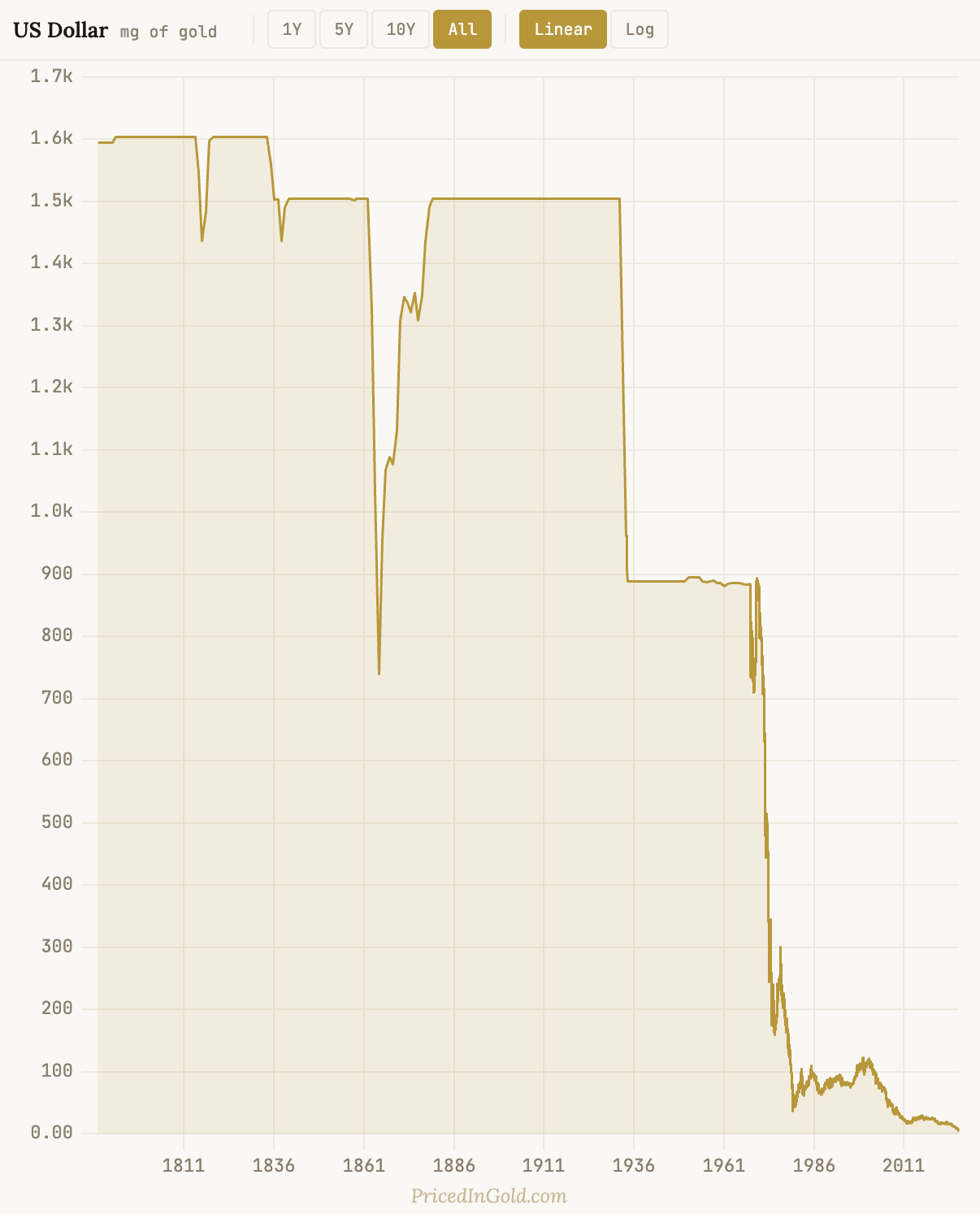
1. The US dollar is down against gold (more than 99% since 1971)
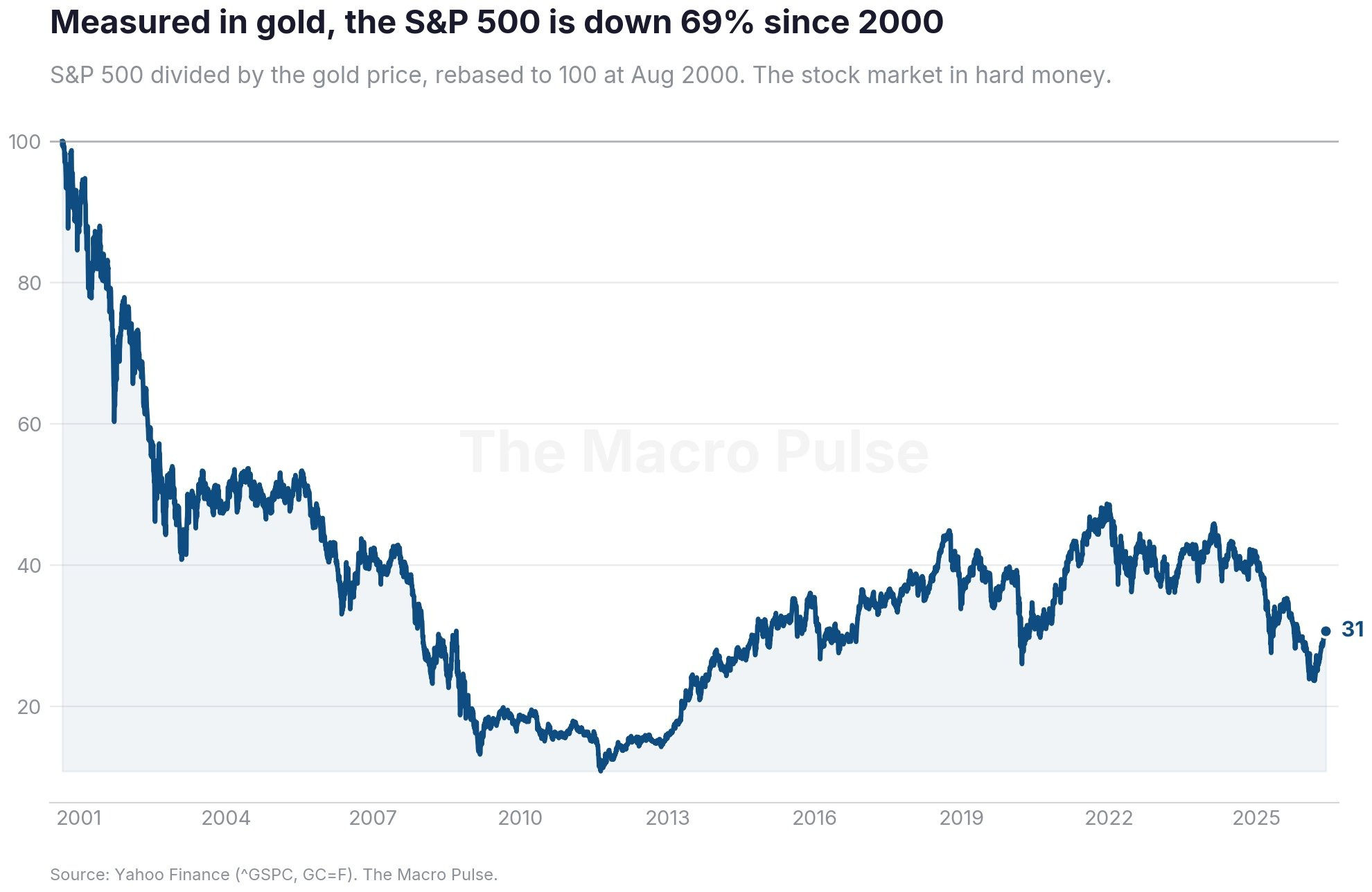
2. The S&P 500 is down against gold
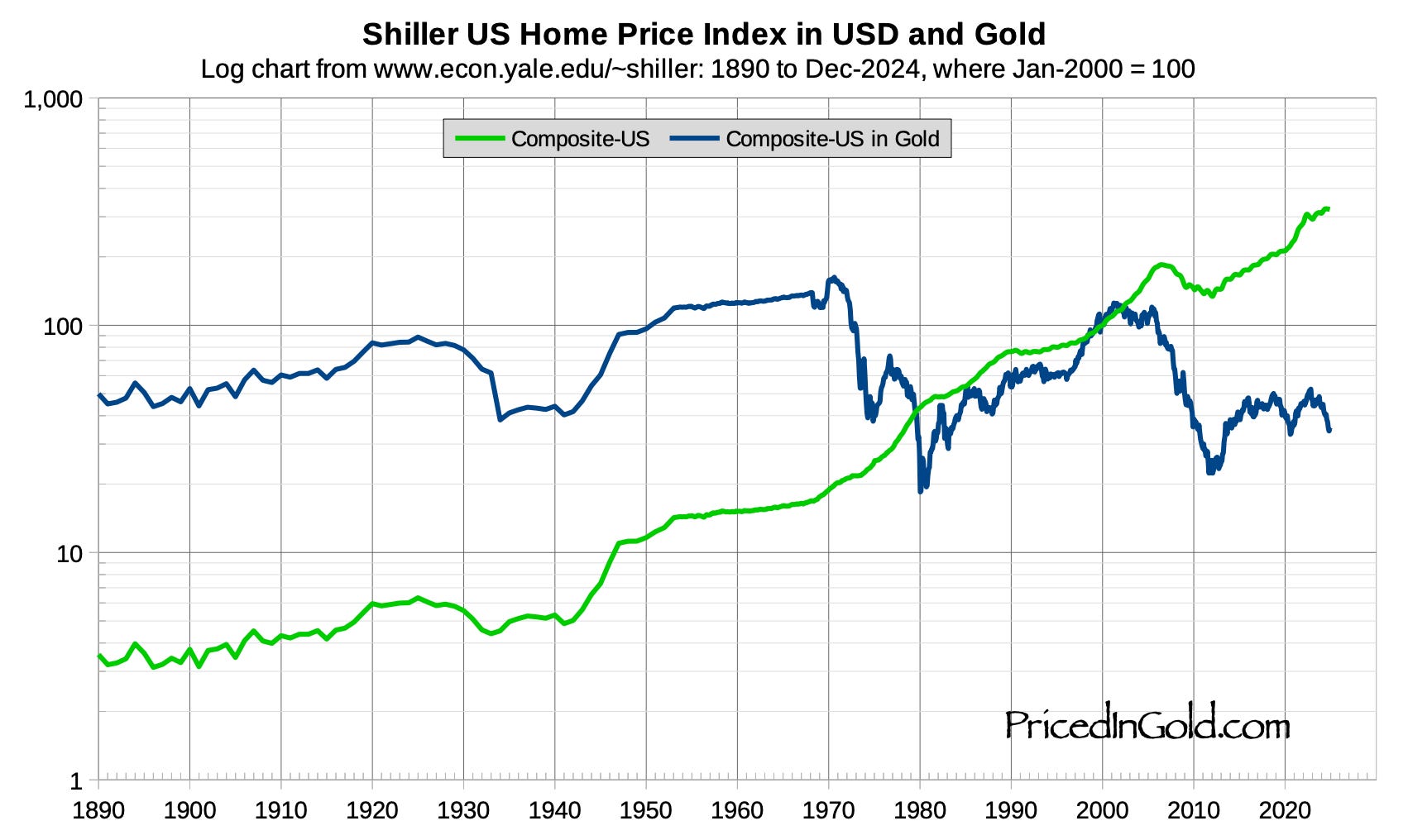
3. US average home prices have collapsed against gold
4. US bonds are in a five-year bear market with inflation trending up
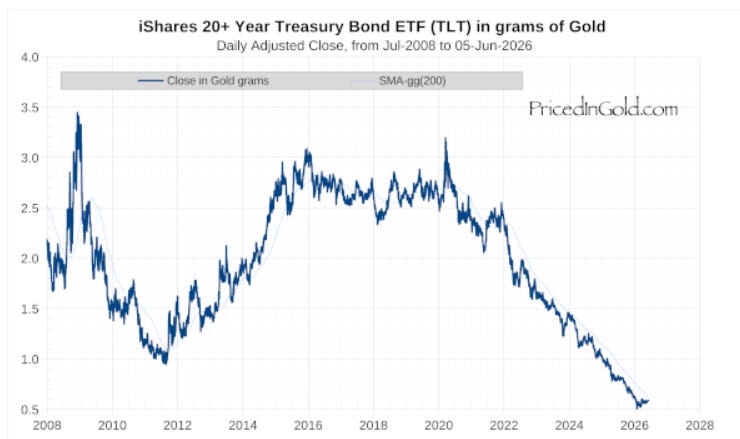
Bonds have fallen 75% relative to gold since 2008. Conventional 401(k) and Wall Street allocations still invest passively into bonds whose purchasing power continues to collapse.
When few are prepared, there’s always opportunity
This is not pure pessimism but a map of the dominant risks and opportunities that most investors misread. Fiat currency collapses are never advertised. A few people recognize them early and prosper. Most never see them coming and get hurt. That gap is where the opportunity lives. Without a clear understanding and a credible strategy, you will not be on the right side of the times ahead.
So learn how and when to allocate to gold and precious metals. It is the one allocation conventional planning completely overlooks. Don’t make the same mistake.
Markets are now moving at a speed and scale of risk most investors have never seen. This is not an aberration. It is the inevitable turbulence of a fiat currency in decline, and the pace will not slow. The only question that matters is whether you are invested appropriately for it.
Failure isn’t being prevented. It’s being postponed.
Money is the hidden constitution of a political order. It determines which risks get rewarded, which institutions survive, and which failures are forgiven. And fiat money reverses the logic of the original constitution. Economic outcomes increasingly flow not from scarcity or market selection but from legal privilege. Its acceptance rests not on earned trust but on legal tender laws, taxation, and institutional inertia. What presents itself as sovereign currency is, in practice, state credit circulating as money. That distinction is not semantic. It is the difference between a system disciplined by external reality and one governed by discretion.
And discretion is a polite term for manipulation.
That discretion is concentrated in the central banks. They present themselves as neutral guardians of stability. In practice, their job is to shield the system from failure: suppress interest rates, guarantee liquidity, rescue whatever is too big to fall. Failure is postponed, growing larger and more dangerous with each cycle.
Postponement requires manipulation. Here is what that looks like across the markets that matter, right now.
Gold
For the dollar to remain credible, its devaluation against gold has to be hidden. Participation is discouraged. Corrections are made as painful as possible. The price is set in paper markets that US monetary authorities can influence.
This can and does work for a time. The dollar has fallen more than 99% against gold since the early 1970s, yet most US investors hold little or no gold, less than 2% in aggregate.
The suppression is visible in the market’s own positioning. Gold remains in a long-term bull market, but engineered volatility has driven short-term traders out. Open interest in gold futures now sits at its lowest level in more than a decade. In the middle of a fiat currency decline, that is extreme and unnatural behavior. It tells you the deterrent is working on everyone who hasn’t studied the history.
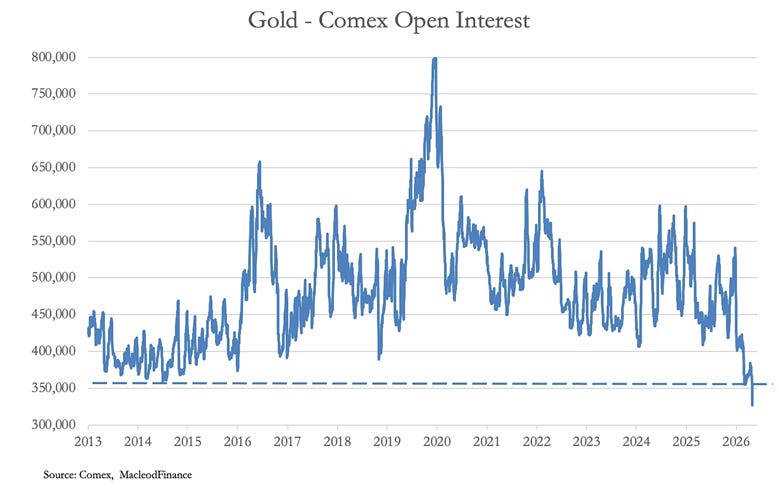
CHART: Gold — Comex Open Interest, 2013–2026 · Comex / MacleodFinance. Decade-low ~350k contracts.
Bonds
High bond yields are kryptonite to an economy carrying this much debt, so bond yields are contained. The instrument is the Treasury’s new buyback program. Announced buybacks track the MOVE index, the bond market’s volatility gauge, with remarkable precision: when volatility threatens to push yields out of range, the buying appears. The Treasury cannot afford a breakout to higher yields, and least of all a sharp one.
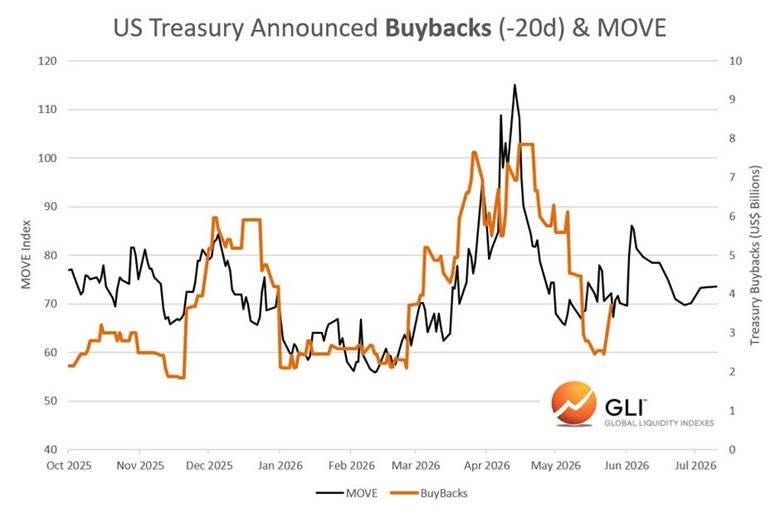
CHART: US Treasury Announced Buybacks (-20d) vs. MOVE index, Oct 2025–Jul 2026 · GLI. The two lines move together.
Oil
High oil prices are the other kryptonite, and oil is harder to control. A physical commodity cannot be set in paper markets the way gold can. So the US uses the Strategic Petroleum Reserve as a price-management tool rather than the emergency reserve it was designed to be.
That strategy has become high-risk. World oil inventories are falling at a record pace, and unless the Strait of Hormuz reopens soon, projections show stocks breaching operational stress levels within months.
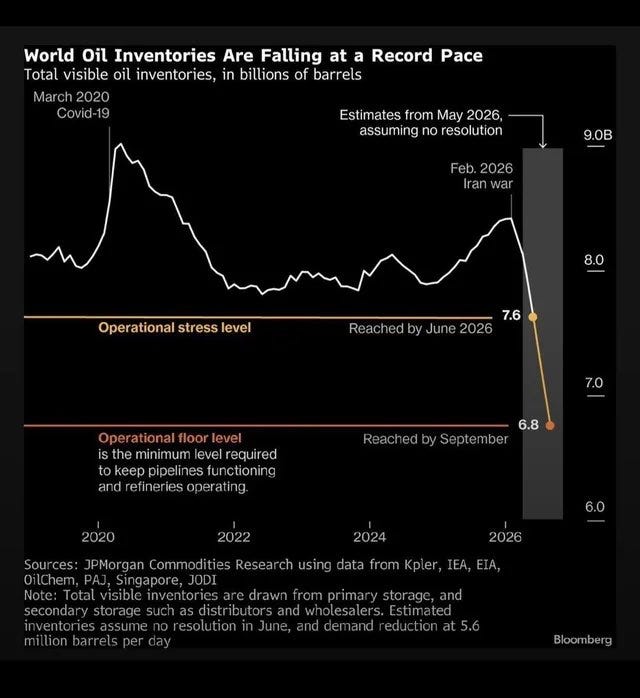
CHART: World oil inventories falling at a record pace, 2020–2026 · Bloomberg / JPMorgan. Projections breach operational stress level by June, operational floor by September.
Manipulation cannot fully control any of these prices. What it can do is soften the blows and slow the transitions. That is what you are watching: not a system being fixed, but a decline being managed.
The greatest test of the fiat system is now upon us
Equities are the showpiece of the managed decline. Easy monetary and fiscal policy pushes stock prices higher in dollar terms, and asset owners feel wealthier. But the same policy devalues the dollar against gold, so the real gains are far smaller than they appear. The S&P 500 has fallen 69% against gold since 2000 while being celebrated as a generational bull market. That is the distortion working as designed.
Now the system faces its hardest test yet: inflation and debt are converging.
Inflation has held above the Fed’s 2% target for six years and is rising again. It is approaching the level that has historically broken US equity valuations relative to CPI over the last 55 years.
With this much debt, the usual remedy is unavailable. The US cannot raise interest rates far enough to contain inflation, because higher rates mean higher interest expense, which adds to the debt, which requires more borrowing. The cure accelerates the disease.
And if inflation is allowed to run, investors will have to face an uncomfortable fact: equities in general are not an inflation hedge. The historical record on this is clear.
The mathematics, the scale, and the absence of any restraint on government debt point one direction: long-term inflation is increasingly out of control.
The winners will understand the predicament
There is enormous opportunity in markets going forward, but not where investors are currently positioned. Equities need near-perfect outcomes to sustain a rally priced at the most extreme expectations and valuations in history.
In the advanced stages of a fiat currency decline, investors face a string of market manipulations and a constant fight to sustain the purchasing power of their accounts. The good options have narrowed. Few investors have any experience with gold and commodity strategies, and advisors in general don’t advocate these allocations.
Passive investing can be the worst approach depending on the era. It was disastrous from 1966 for fifteen years, and again from 2000 for thirteen. Another period of passive failure is highly likely now upon us, and this time the system itself will likely need a major reset.
As we have shown in recent articles, very few professional investors or advisors understand how to compound returns in a dynamic system. Fewer still have lived through conditions like these or recognize the long-term trends of a decaying fiat currency.
The winners of this transition will understand the predicament and navigate their allocations through the turbulence. That is a learnable skill, and it is what we do.
See what efficient compounding looks like
We’re putting together a full demonstration of how we navigate conditions like these in everything we do: the allocation logic, and how we judge results by return per unit of drawdown (the Calmar ratio), not returns alone. We’re building it out in public, right here on Substack, and it will be published when it’s ready.
Conventional financial advice is failing investors at the moment it matters most. That is why Best Interest Wealth Management (BIWM) exists: we want investors to understand this predicament thoroughly enough to invest in their own best interest.
Subscribe so you don’t miss it. You’ll get every article in the meantime, and we cover these questions live in our Market Insight livestreams, Fridays at noon EST. Bring your hardest question.