
The Illusion of Wealth
Since the turn of the century, the S&P 500 is up almost five times. That sounds like a generation of wealth creation. It isn’t.
Measured in gold over the same period, the S&P 500 has lost 75% of its value. Investors could have saved decades of time, energy, and fees by owning an inactive lump of metal and doing nothing. They would be four times wealthier today.
How is that possible? Because the unit you’re measuring in is collapsing. The dollar isn’t a stable yardstick — it’s a shrinking one. And when the ruler is shrinking, everything measured by it looks like it’s growing.
This is the most important question in investing that almost no one is asking: are your returns real, or are they an illusion created by a declining currency?
Conventional investment advice has no answer. It doesn’t even acknowledge the question. It measures your portfolio in dollars, reports dollar returns, and calls it progress. Meanwhile, the purchasing power behind those dollars quietly erodes year after year.
With the Capital Rotation Event signaled at the end of 2025, this erosion is likely accelerating. What has been a slow bleed is becoming something much more urgent. To understand why — and what to do about it — we need to start with a question that sounds simple but changes everything.
What is money?
What Is Money, Really?
Over two thousand years ago, Roman law answered this question plainly. Money was coined metal — something with no counterparty risk, a thing of value in itself, not a promise from someone else.
Gold has carried that role ever since. Under common international law, gold is final settlement for all transactions. It doesn’t depend on a government keeping its word or a central bank managing its balance sheet. Gold is valued for what it is, not for what someone promises it’s worth.
What most people call “money” today is something fundamentally different. Dollars are credit — issued by a government agency with an unfulfilled promise to settle in gold. That promise was revoked decades ago, which is exactly what the word “fiat” means: by decree, not by substance. But revoking the promise doesn’t change the underlying reality. Gold remains money. Dollars remain credit.
This distinction matters enormously. When you hold gold, you hold final settlement. When you hold dollars, you hold someone else’s obligation. And the track record of those obligations is, without exception, a one-way trip toward zero.
If that sounds abstract, it isn’t. There’s a YouTube Short from Africa showing a man with a 1 million bill in local currency — and it isn’t enough to exchange for even toilet paper. That isn’t some distant historical curiosity. It’s where all fiat currencies eventually arrive. The only question is how long the journey takes.
With these terms clear — money as gold, currency as credit, and value as purchasing power — the conventional story about investment returns starts to unravel.
The One-Way Track Record
This isn’t speculation. It’s a pattern with no exceptions.
Over the last 100 years, every major fiat currency has lost between 97% and 99% of its value against gold. Every single one.
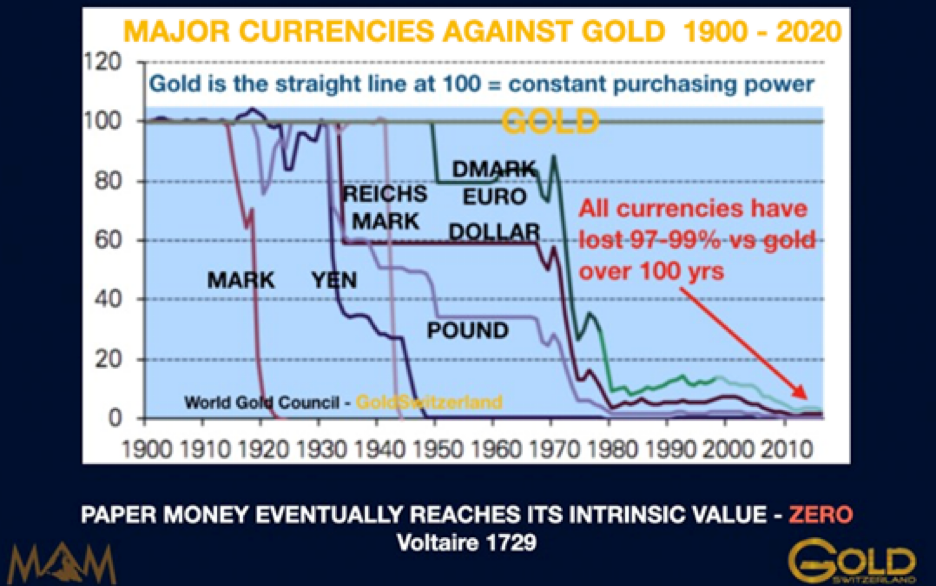
Look at the chart carefully. Gold is the flat line at the top — constant purchasing power. Everything else collapses beneath it. The euro. The pound. The yen. The dollar. The trajectory is identical. The only difference is speed.
As Voltaire observed nearly three centuries ago: “Paper money eventually reaches its intrinsic value — zero.”
What makes this uncomfortable is that the US dollar is not exempt. It’s further along the curve than most Americans realize, and the pace is picking up. The dollar has already lost over 98% of its purchasing power against gold since 1900. The remaining 2% is not a floor — it’s a countdown.
This is not a fringe view. It is the exposed record of what happens to every government-issued currency in history. There are no exceptions. The question isn’t whether this is happening. It’s what your wealth actually looks like when conventional investing fails to adapt.
The World Measured in Gold
So what does it look like when you switch the yardstick?
Start with the stock market. In dollar terms, the S&P 500 has climbed from 100 to nearly 500 since the year 2000. An impressive run by any conventional measure. But priced in gold, that same index has fallen from 100 to 26.
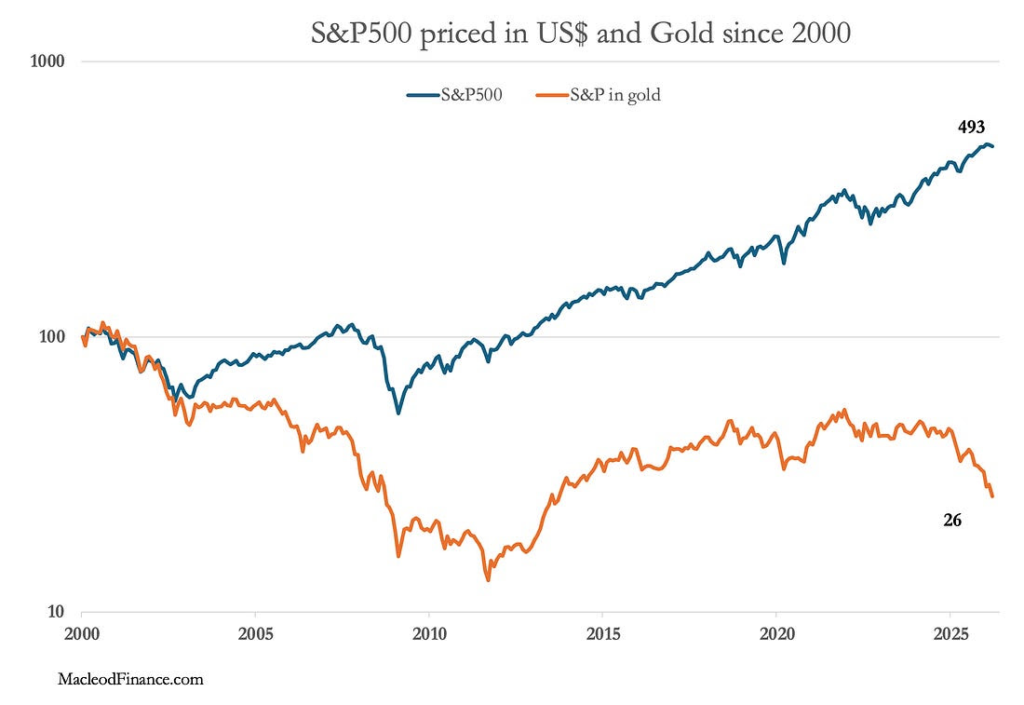
Two lines on the same chart. One tells you you’re thriving. The other tells you you’ve lost three quarters of your purchasing power. Both are factually accurate. The difference is what you choose to measure against — a depreciating credit instrument, or money that has held its value for millennia.
Now consider something closer to daily life: energy.
Oil prices have risen 38 times in dollar terms since 1970. That’s the number behind every spike at the gas pump, every inflation headline, every squeeze on household budgets. But priced in gold, oil has actually gotten *cheaper*. Significantly cheaper.
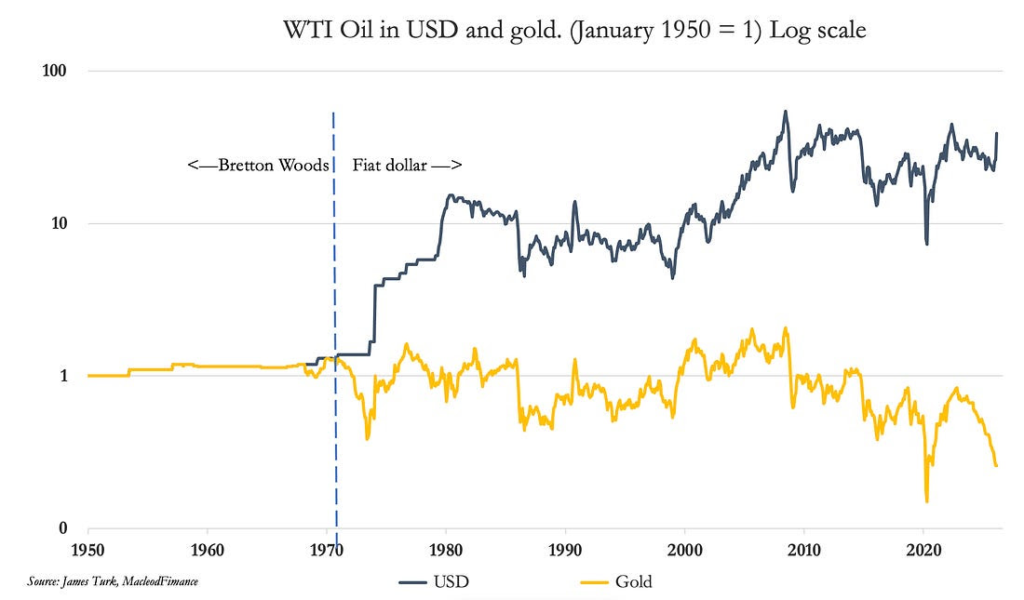
This is the same reality viewed through two different lenses. In one, the cost of living is spiraling. In the other, the world is getting more affordable — if you hold the right form of money. The pain isn’t coming from oil getting more expensive. It’s coming from the dollar getting weaker.
The main purpose of investing is to preserve or grow purchasing power for when you no longer earn an income. If the yardstick you’re using to measure progress is itself in decline, you aren’t just misinformed — you’re making decisions on a foundation that is actively misleading you.
The Phase Transition Is Underway
For extended periods — years, even decades — the decline of fiat currencies against gold can appear glacially slow. Slow enough to ignore. Slow enough for conventional wisdom to explain away.
But there are moments when the pace changes. We are in one now.
Over the last two years, gold has broken out to historic highs. Central banks around the world have been shifting their reserve allocations away from dollars and toward gold. Global debt has exploded to levels that strain credibility. And at the end of 2025, another Capital Rotation Event was triggered — a signal that the relationship between credit and money is entering a new phase.
These aren’t disconnected data points. They are symptoms of a system under stress. Aggressive intervention creates distortion. Distortion erodes credibility. And when credibility fails, the credit built on top of it fails too.
This is the cycle that has played out with every fiat currency in history. Governments can always expand the money supply to finance rising spending. For a while, the system absorbs it. But at some point, the gap between what the currency promises and what it can actually buy becomes too wide to bridge. Confidence doesn’t erode gradually. When it goes, it goes all at once.
The message from gold is clear: the S&P 500 is massively distorted. That message is reinforced by every long-term perspective we’ve covered in these articles. What felt like a stable system was, in reality, a system being propped up by increasingly aggressive interventions. Those interventions are now running out of road.
This phase transition will likely reshape the global financial system and markets. The process has already begun.
What This Means for You
For over two thousand years, gold has preserved purchasing power. For a few decades, the modern financial system convinced most investors that this time was different. It isn’t.
The conventional playbook — dollar-denominated returns, passive index funds, traditional advisory models — was built for a world where the dollar’s decline was slow enough to ignore. That world is ending. The signals are everywhere: in the gold price, in central bank behavior, in the debt levels, in the Capital Rotation Event. What was once background noise is now impossible to dismiss.
The good news is that none of this is a surprise if you’ve been paying attention. The pattern is ancient, well-documented, and repeatable. Investors who understand the difference between money and credit, who measure their wealth in purchasing power rather than nominal dollars, and who position accordingly don’t just survive these transitions. They come out stronger.
But very few advisers know how to navigate what’s ahead. Fewer still have a track record that demonstrates they can protect and grow purchasing power in dramatically changing conditions. This isn’t a time for conventional thinking. It’s a time for a complete reassessment of what your wealth actually looks like and what strategy will preserve it.
If you want to review your investment approach for the conditions we are now in, set up a call.
Cheers, Chris.