
Investment management got lazy during the longest US equity bull market in history. Risk management seemed like a handicap. The more reckless the approach, the higher the short-term gains. Allocations to US equities reached all-time highs. Never-ending gains became the base assumption.
That assumption just broke. Now the pain trade begins.
Most investors will only change their allocation when the pain of short-term losses becomes too great. By then, the damage to their long-term compounding is already done.
Conventional asset management isn’t just underperforming. It has structural failures that most investors have never examined.
Compounding is the real engine of wealth, and optimal compounding requires proactive processes to accelerate the positive effects.
Options trading, when applied correctly, can amplify that compounding while embedding the tightest risk management available. But it starts with getting the core discipline right.
Where Conventional Asset Management Falls Short
Most investors have yet to understand that conventional asset management is falling further and further behind best practice investment management. At best, it will produce long-term suboptimal results with unnecessarily high risk.
The failures are structural:
- No credible long-term strategy. Most managers use a passive allocation portfolio, which is sub-optimal at the best of times and absolutely destructive when market cycles change. Spoiler: that time is now.
- No use of options for risk management. Options are the most precise tool available for managing risk, and most managers ignore them entirely.
- No compounding discipline. The number one rule of compounding is to minimize drawdown, the loss from peak to trough until the peak is regained. A 50% loss requires a 100% gain just to recover. Most managers have abdicated this responsibility entirely.
- Flawed assumptions about risk and return. The entire industry is built on the idea that higher risk produces higher returns. The data says the opposite: risk is not the engine of long term returns, it’s a danger to be managed.
These aren’t minor gaps. They are fundamental failures in how money is managed — and they were easy to ignore during a relentless bull market where recklessness was rewarded.
That market is over.
The Capital Rotation Event Has Triggered
The signal we have been tracking could not be clearer, and it has defined changes in the investment environment for over a hundred years.
In the last quarter of 2025, the Capital Rotation Event was triggered. Gold is breaking higher versus US equities. All 11 S&P 500 sectors are now in bear markets relative to gold. The US Dollar Index, CPI, PPI, the Dow Jones, the Russell 2000, the Wilshire 5000: all in bear markets versus gold.
This is not a temporary dislocation. This is the pattern that preceded every major capital rotation going back to the 1920s. When this signal fires, core allocations need to change.
Waiting for losses to force that change is the most expensive mistake a compounder can make. Every drawdown that could have been avoided is a permanent setback to long-term returns.
The good news is that a proven approach exists, one that can navigate this transition (and automatically transition through every investment environment) with extremely tight risk management and position credibly and successfully for the decade ahead.
Compounding Options Trading: How It Works
The foundation of best practice investment management is a compounding discipline with rigorous risk control. Options trading, applied correctly, takes that discipline further by embedding precise risk management at every level of the portfolio.
Here is how it works in practice, using an actual portfolio as an example.
Three levels of risk management. A best practice compounding portfolio tracks risk from the top down. At the highest level, the whole account must stay within tight loss limits. Within the account, each model (a group of positions with a shared strategy) has its own limits. And within each model, every individual position is monitored against its own threshold. If something is going wrong, you see it at the position level before it ever threatens the model, and at the model level before it ever threatens the account.
This portfolio is broken into four models:
- CapP focuses on long-term real capital preservation.
- Equities covers any listed equity position worldwide.
- Multi Asset targets the optimal allocation across all asset classes globally.
- Independent holds long-only options positions.
Each model serves a distinct role, but the Independent model is where options transform the portfolio’s capabilities. Long options positions incorporate embedded risk management because every position has a predefined maximum loss. When you buy an option, the premium you pay is the most you can ever lose on that position, no matter what the market does. That cost is known and fixed from the moment you enter the trade.
This is where the asymmetry becomes extraordinary. In the current portfolio, total option premiums add up to less than 2% of the account. If every single option expired worthless, 2% is the total damage. But if the options move as positioned, those same low-cost positions give the portfolio effective exposure equivalent to being over 50% short equities and over 50% long gold and commodities. That exposure comes on top of everything else the portfolio already holds.
In plain terms: a small, defined cost buys the ability to participate massively in the market rotation that the CRE is signaling, without putting the rest of the portfolio at risk. That is the combination that makes this approach unbeatable.
Portfolio Snapshot
The table below shows a real portfolio operating this approach in real time.
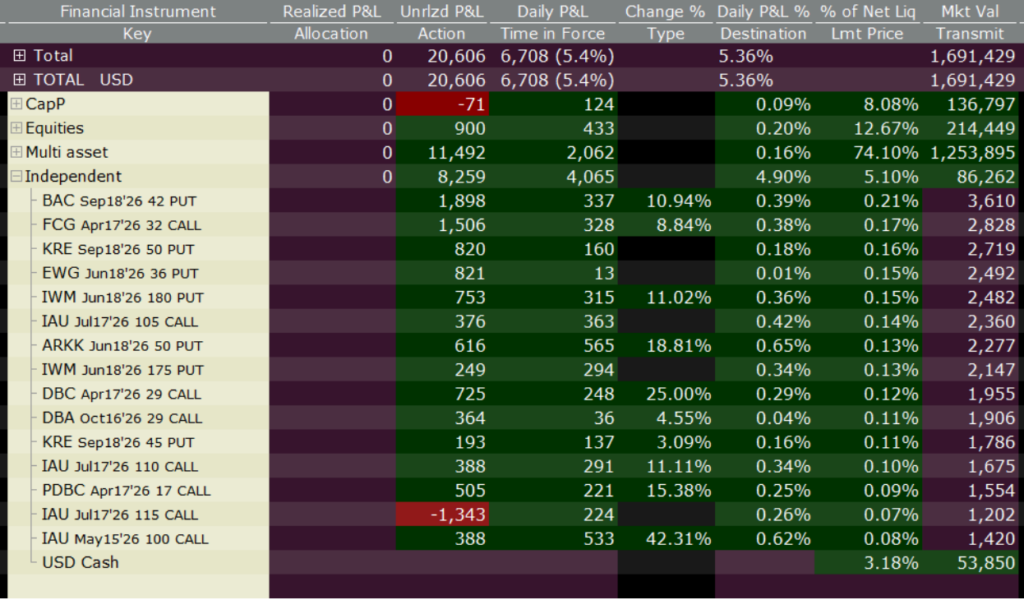
Look at what is happening across the four models. CapP sold precious metals early in the recent drawdown and is awaiting new setups with very limited risk. Equities similarly holds few positions, waiting for the right entries. Multi Asset has rotated into commodities and is making gains. Independent is using options to build asymmetric exposure to the new trend in favor of gold and commodities relative to equities.
This is not a theoretical exercise. This is active, real-time risk management producing results while keeping total risk capital extraordinarily low.
Five things stand out:
- Risk management is extremely tight. Losses are monitored and controlled at every level, in real time.
- It operates in real time, highly effectively. Positions are adjusted as conditions change, not rebalanced on a quarterly schedule.
- Risk capital is extremely low. The total cost of all options positions is less than 2% of the account.
- The potential for gains is enormous. Small premiums create exposure to the strongest expected return trends.
- It compounds safely at speed. When short-term gains are consistently positive, this approach compounds at a faster rate than any other investment approach, while embedding huge exposure to the positions with the best expected returns.
The divergence between this approach and conventional investment management has already started to become spectacular. And the reallocation in favor of gold and commodities has hardly even begun.
Isn’t it time to transform investment management from “I hope this works because we don’t plan to do anything to your account,” to “we are fully committed to preserving your capital, outperforming all benchmarks with lower risk, all with a track record that demonstrates this”?
If you want to review your investment approach for the conditions we are now in, set up a call.
Cheers, Chris.