In Part 1 of this series, we fixed your service structure, ensuring you have coordinated, proactive advice rather than fragmented silos. In Part 2, we taught you to read your 1040 like a planning tool, not just a compliance document. In Part 3, we showed how coordinated planning across finances, retirement, and estate creates real leverage.
We originally planned five parts. But as this series has developed, it’s become clear that this final topic deserves to stand on its own as the conclusion — because investment strategy and tax efficiency are where everything we’ve built so far either compounds in your favor or works against you.
There are three vital components of reliable wealth growth over a lifetime:
- A consistent ability to live within your means and save.
- A compounding investment approach: a repeatable process which secures your wealth and continues to outgrow its benchmarks.
- A strategy that minimizes lifetime taxes.
The first is up to you. The second and third are what this article is about — and as you’ll see, they’re far more connected than most investors realize.
Compounding and Tax Minimization Are a Natural Fit
Effective compounding and tax minimization are not competing goals. They reinforce each other. The discipline that drives superior long-term compounding uses aggressive risk management to minimize drawdowns and so also minimizes after-tax losses.
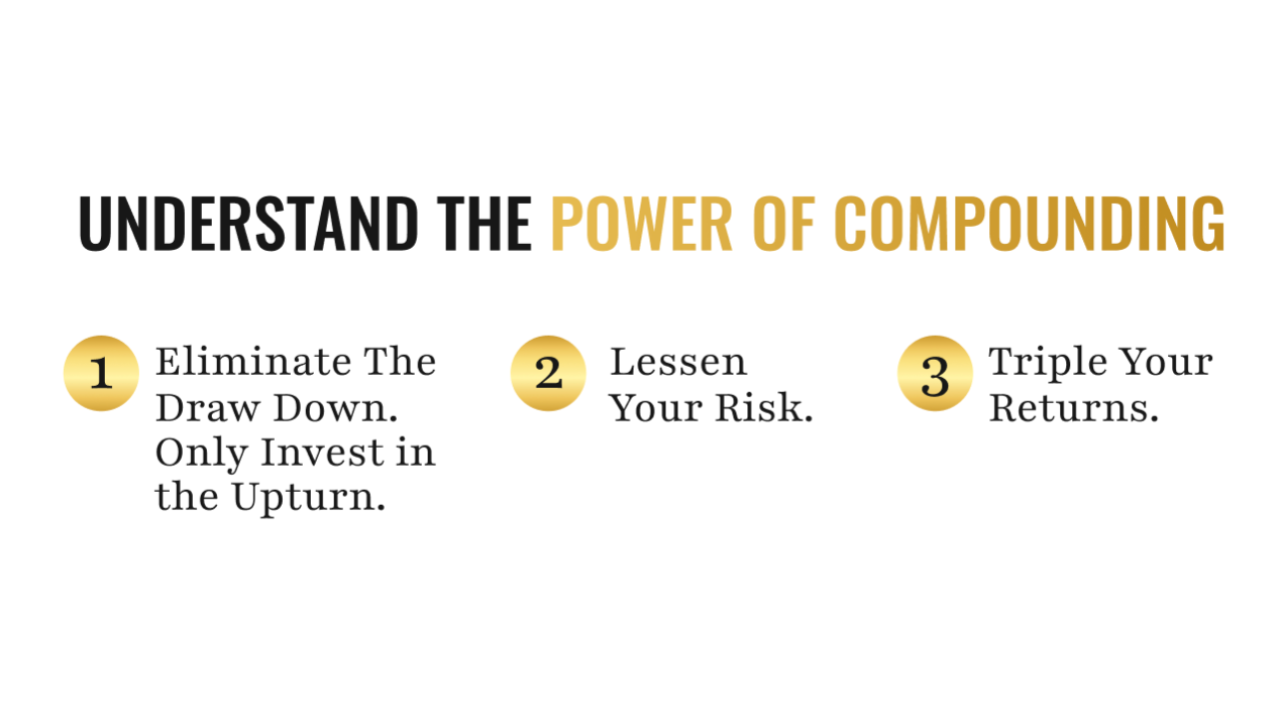
The chart below illustrates the point. Over roughly two decades, a disciplined compounding approach applied to the S&P 500 delivered nearly 3x the cumulative return of a passive allocation while also taking less risk. By eliminating drawdowns and investing only in uptrends, the approach lessens risk and dramatically improves long-term results. These are mathematical conclusions explored in depth in Invest Like the Best.

This completely contradicts conventional assumptions. Most investors believe higher returns require higher risk. This is provably incorrect. A structured, transparent compounding process shows the opposite, and the tax implications follow naturally.
In the short term, compounding discipline often means realizing gains and paying taxes during uptrends. Negativity bias makes those tax payments sting disproportionately. We fixate on the outflow rather than the far larger net wealth created. But tripling your ending value through better compounding produces dramatically more after-tax dollars than a buy-and-hold strategy, even after taxes are paid along the way. No realistic tax regime in history would reverse that outcome. More gross wealth, structured efficiently, always leaves you ahead.
The deeper tax advantage, however, lies in loss prevention. Capital losses offset gains dollar-for-dollar, but any excess can reduce ordinary taxable income by only $3,000 per year ($1,500 if married filing separately). Anything beyond that limit becomes a pure, permanent loss of capital with no tax benefit and no recovery. By minimizing the size and frequency of drawdowns, a compounding-focused process keeps these unoffsettable losses as small as possible, even in severe market environments. Fewer large setbacks mean fewer losses and smoother, more tax-efficient long-term growth. This is the foundation. But how compounding is applied depends heavily on where your money sits, and not all accounts are treated equally by the tax code.
Not All Accounts Are Created Equal
The tax status of your accounts is one of the most important variables in how you compound your wealth. The same investment approach can produce very different after-tax outcomes depending on where it’s executed. There are three main types of accounts for tax purposes, and each one calls for a different strategy.
Roth IRAs are the best ultimate destination. Contributions are made with after-tax dollars, but all growth and withdrawals are tax-free for life. That means you can focus entirely on maximizing your compounding return without worrying about the tax consequences of trades, rebalancing, or withdrawals. Over a lifetime, the value of that freedom is enormous. Everything else being equal, your planning should favor moving as much capital into Roth accounts as possible.
Taxable accounts pay full tax every year. In these accounts, every realized gain, dividend, and distribution creates a taxable event. Frequent trading can trigger short-term capital gains taxed at ordinary income rates as high as 37%. High turnover also creates complex reporting issues. Many active traders don’t realize until filing season that how they trade can matter just as much as how well they trade. Unfortunately, by the time most investors discover these issues, it’s often too late to fix them for the current tax year. Trading structure directly affects taxes, risk, and flexibility.
Tax-deferred accounts (IRAs and 401(k)s) sit in between. Contributions are tax-deductible and growth is untaxed while it stays in the account, making them clearly better than fully taxable accounts during the accumulation phase. But before that money becomes yours, you have to pay taxes on every dollar withdrawn. This gives rise to one of the most important tax planning problems that most investors don’t understand and really must address.
The earlier you plan for withdrawals, the wealthier you will be. Immediately upon investing in tax-deferred accounts, you need a lifetime strategy for how and when to convert or withdraw that money. Roth conversions, done strategically over time, can save hundreds of thousands in lifetime taxes. The longer you can compound tax-free, the better the outcome. But conversion timing is a complicated issue that requires excellent planning software and a deeply experienced advisor. Waiting too long limits your options. Starting early, even years before retirement, preserves flexibility and can be a genuine game changer.
If you’d like to understand the background on this planning challenge in more depth, we’ve written about it here.
Compounding Gets Even Better with Options
Options are a powerful addition to a disciplined compounding process. For investors focused on maximizing after-tax returns, a manager who never trades options is leaving real money on the table, both in growth and in tax savings.
For those less familiar: a Call Option gives you the right to buy a stock at a set price within a set time frame. You get the upside potential without putting up the full cost of the stock. A Put Option gives you the right to sell at a set price, which puts a floor under your losses. In both cases, the most you can lose is the price you paid for the option itself. These two tools, used individually or together, are what make options so useful within a compounding framework.
Options help in two important ways.
First, they accelerate compounding by limiting losses and increasing upside.
Put Options cap your downside. You know your worst-case loss before you enter the trade. Call Options let you participate in gains without committing full capital. The result is lopsided in your favor: small, contained losses and larger potential gains. That asymmetry is exactly what compounding thrives on. Drawdowns shrink, your capital stays intact longer, and long-term growth improves significantly.
This is worth emphasizing: options can increase returns while lowering risk. That sounds contradictory, but it makes perfect sense through the lens of compounding. Within a disciplined process, options don’t add danger. They amplify the very dynamics that make compounding work.
Second, they give you control over when you pay taxes.
Selling covered calls against stocks that have grown significantly generates immediate income through the premium you collect, while you keep the underlying stock. If the call expires unused, you keep the premium and your position. If the buyer exercises the call, the premium adds to your sale proceeds, and the gain on the stock can still qualify for the lower long-term capital gains rate (0–20%) if you’ve held it long enough.
By choosing the right terms and timing, you control when large gains hit your tax return. You can spread them across multiple years, stay in lower tax brackets, and avoid realizing too much in any single year. The result is lower lifetime taxes without changing what you own.
A critical caveat. Options only work this way when they sit on top of an already disciplined investment process. Without drawdown control and a compounding-focused foundation, they can become dangerous. They enhance a sound framework. They don’t replace one.
If your current strategy doesn’t use options as a deliberate tool for growth and tax timing, it may be worth a closer look. A best-practice framework can show exactly how they fit your goals and tax picture.
Series Summary
Minimizing taxes and maximizing compounding isn’t flashy. It doesn’t generate headlines. But it may be the most reliable way to improve long-term results without taking on additional and unnecessary risk.
Over the course of this series, we’ve built a complete picture of what best-practice tax services actually look like. It starts with the right service structure. It requires understanding what your tax return is really telling you. It depends on coordinated planning across your finances, retirement, and estate. And it comes together here, where investment strategy and tax efficiency work together.
Understanding how your investment activity is structured, and making sure it aligns with compounding discipline, tax efficiency, and your personal goals, are among the most important steps you can take as an investor. Coordinating all of this within a comprehensive wealth management framework is how these pieces stop competing and start compounding together.
If you’d like to explore how these ideas apply to your own situation, we’d welcome the conversation.
Cheers, Chris